 Recent Results Reported by Our Group Recent Results Reported by Our Group |
- We have found that only one donor atom determines early stages of ID vs. VG characteristics, even under the presence of many dopants. When the gate voltage is swept in the positive direction, before the channel current starts to flow, several isolated current peaks can be observed. We showed that these are due to single-electron tunneling via single donor atoms. This finding proves that atomic tunneling devices can be realized by appropriate choice of gate voltages, even if the number of dopants in the channel is larger than one. (Phys. Rev. Lett. (2010)).
|
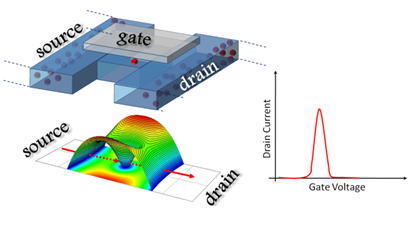 |
| Fig:A single-donor potential controlling single-electron tunneling current |
- Electron shuttling between two donors is observed as a hysteresis of ID vs. VG characteristics. This phenomenon is important for developing atom-based memory devices, as well as future quantum computing devices. (Appl. Phys. Lett. (2010)).
|
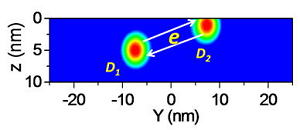 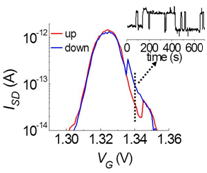 |
| Fig:Single-electron transfer between two donors in a nanoscale channel |
- We have shown that single-electron turnstile operation can be achieved even in the presence of random fluctuation in positions and numbers of Si dots. Originally, single-electron turnstile was proposed based on a 3-dot system. We found, however, from simulations that this ordered transfer operation can be achieved even when there are fluctuations in the arrangement and number of dots. (J. Appl. Phys. (2010)), Jpn. J. Appl. Phys. (2009)). We had demonstrated this by a previous experiment, using random donor potentials to achieve turnstile function (Phys. Rev. B (2007)). This finding is useful for nanometer-scale devices, since such fluctuations cannot be completely removed.
In addition, by selecting a device, in which only three donors determine the ID-VG characteristics, we achieved single electron turnstile operation. The operation of these devices was found to be tunable using the back gate voltage. (Appl. Phys. Express (2009)).
|
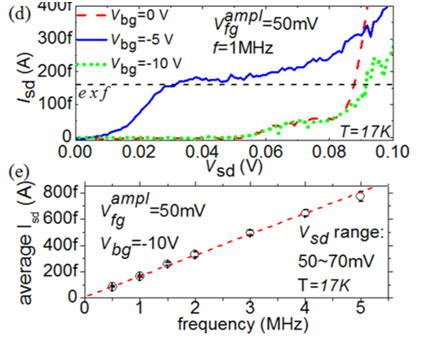 |
| Fig:Single-electron turnstile operation based on discrete dopant atoms. |
- We have demonstrated that Si multi-dots FETs can detect single photons as a sudden change of drain current, due to trapping of photo-generated elementary charge in a quantum dot. (Phys. Rev. B (2006)). More recently, an identical principle was demonstrated for devices in which the dots are created by discrete donors. (Phys. Status Solidi A (2011)).
|
- We have succeeded in observation of individual dopants (P and B) in the Si channel by Low-Temperature Kelvin Probe Force Microscopy. This technique provides essential information for future development of single-dopant devices. (Appl. Phys. Lett. (2008), Thin Solid Films (2010)).
|
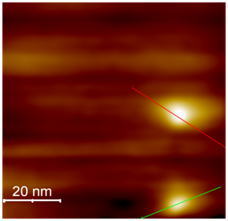 |
| Fig:Potential of boron ions in Si observed by LT-KFM |










 ACTIVITIES
 Events